The Science of Reading: How Your Brain Decodes Text
Reading feels effortless once you can do it, but the brain has to improvise a remarkable circuit: turning marks into sounds, sounds into meanings, and meanings into thought.
DistilledReads ·
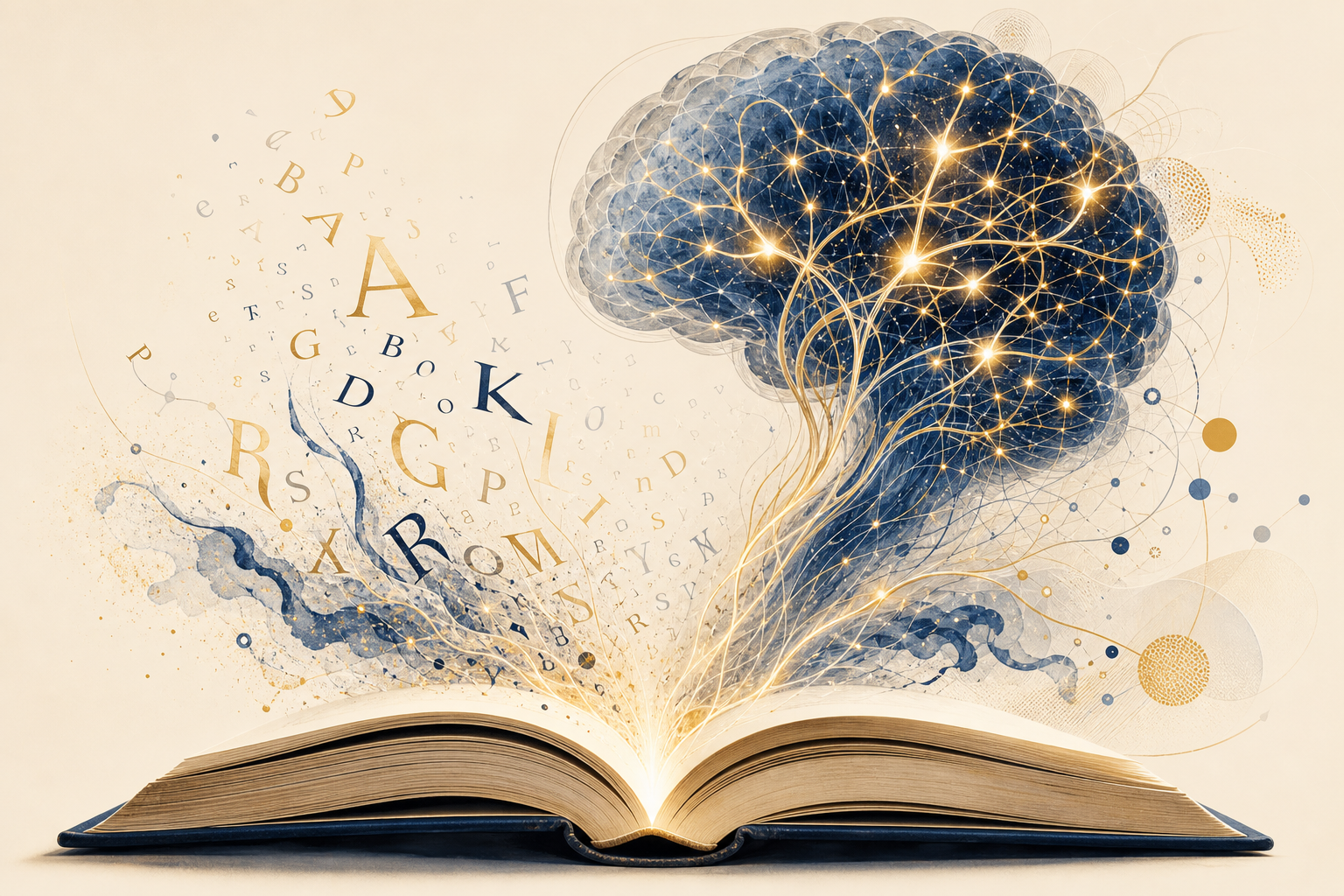
Reading is so familiar that it is easy to mistake it for a natural human ability. Speech is different. Barring unusual deprivation or impairment, children acquire spoken language because the human brain evolved for it. Reading has no such deep evolutionary pedigree. Alphabetic writing is only a few thousand years old; mass literacy is far younger. The brain did not evolve a dedicated “reading organ.” It learned to repurpose older systems built for vision, language, attention, and memory.
That makes reading one of the most astonishing acts of cultural recycling in human life. When you see the word river, your eyes register a pattern of strokes; your visual system normalizes that pattern across fonts, cases, sizes, and handwriting; language systems connect it to sound and meaning; memory supplies associations; attention keeps the sentence active long enough for syntax to do its work. The experience feels immediate because, in fluent readers, the circuit has become highly practiced.
The brain borrows what it already has
Neuroscientist Stanislas Dehaene has argued that literacy works through “neuronal recycling”: culture finds a use for neural machinery that evolved for other tasks. One famous example is the “visual word form area,” a region in the left occipito-temporal cortex that becomes tuned to written words. Before literacy, this region helps recognize visual objects and shapes. After years of exposure to print, it becomes exquisitely sensitive to letter strings.
This tuning is not the same as memorizing every word as a picture. Skilled reading depends on pattern recognition at multiple levels: letters, letter clusters, morphemes, word forms, and sentence context. The brain learns that cat, cats, and catlike are related; that gh behaves differently in ghost, though, and laugh; that the shape b is different from d even though the same strokes are mirrored. These are not trivial distinctions. They require the visual system to overcome some of its own useful habits.
In ordinary object recognition, mirror invariance is helpful: a chair is still a chair if seen from another angle. In alphabetic reading, mirror confusion can be costly. The brain must learn that orientation matters. That is one reason early readers often reverse letters. The mistake is not laziness; it is the brain applying a perfectly reasonable visual rule to a cultural invention that demands the opposite.
Phonics is not ideology; it is architecture
One of the strongest findings in reading research is that most alphabetic readers benefit from explicit instruction in the relationship between graphemes (written marks) and phonemes (speech sounds). This is the core of phonics. The reason is straightforward: alphabetic writing is a code for spoken language. To read a new word, a child must learn how print maps onto sound.
That does not mean skilled readers sound out every word consciously. They do not. Fluent reading becomes rapid and automatic. But the automaticity is built on a foundation of decoding. A child who can map sh, ch, th, vowel teams, and common spelling patterns onto speech has a tool for unlocking unfamiliar words. A child who is asked to guess from context or memorize word shapes is being denied the engine that makes independent reading scale.
The “science of reading” movement can become a slogan, but its central insight is valuable: reading is not simply exposure plus enthusiasm. For many children, especially those at risk for dyslexia or language-based difficulties, systematic instruction matters. It does not kill the love of reading. It gives children a way into it.
Comprehension is more than decoding
Decoding is necessary but not sufficient. A child can pronounce the words in a sentence and still miss the point. Reading comprehension depends on vocabulary, background knowledge, working memory, syntax, inference, motivation, and attention. Consider a sentence like:
The committee tabled the motion after the chair ruled the amendment out of order.
You can decode every word and still struggle if you do not know parliamentary procedure. This is why knowledge matters. Reading comprehension is not a single generic skill that transfers cleanly across all topics. The more you know about a domain, the more efficiently you can interpret texts within it.
This has an important consequence: if we want better readers, we cannot only teach “reading strategies.” Strategies such as summarizing, predicting, and asking questions can help, but they are not substitutes for knowledge. A student who has learned about ancient Egypt will read a text about papyrus, scribes, and temples with more ease than a student encountering every concept for the first time.
In other words, the best reading curriculum is also a knowledge curriculum. Books feed the very background knowledge that makes future books easier to understand.
Fluency frees the mind
Fluency is sometimes misunderstood as speed. Speed is part of it, but fluency also includes accuracy, phrasing, and expression. A fluent reader does not labor over every word. That matters because working memory is limited. If too much mental energy is spent decoding, little remains for meaning.
Think of learning a musical instrument. At first, every note is effort. Eventually, the musician can attend to phrasing, emotion, and interpretation because the mechanical act has become automatic. Reading works similarly. The goal is not fast reading for its own sake; it is freeing the mind for comprehension.
This also explains why rereading can be powerful. The first pass may be spent building a rough map. The second pass often reveals structure. The third may expose nuance. Good readers are not always the people who race through books. They are often the people who know when to slow down.
Dyslexia reveals the hidden machinery
Dyslexia is not a lack of intelligence. It is a language-based reading difficulty often involving phonological processing: the ability to identify and manipulate the sounds of speech. Because alphabetic writing depends on mapping print to sound, phonological weaknesses can make decoding unusually difficult.
The existence of dyslexia is a reminder that reading is constructed. If reading were natural in the same way speech is natural, we would expect fewer children to need explicit support. Instead, dyslexia shows how many specialized processes must cooperate. When one part of the circuit is inefficient, the whole experience changes.
The hopeful news is that targeted instruction can help. Structured literacy approaches — explicit, systematic, cumulative, and multisensory — are designed to strengthen the code-based skills that struggling readers need. The goal is not to “fix” a mind but to give it better tools.
Reading changes the reader
Once the circuit is built, it does more than decode words. Reading becomes a way to extend attention, simulate other minds, preserve knowledge, encounter arguments, and revise the self. A page is not just information storage. It is a cognitive environment: quiet, structured, replayable, and patient.
That patience is one of reading’s great gifts. A conversation disappears as soon as it happens. A lecture moves at the speaker’s pace. A screen feed pressures you toward the next item. A book waits. You can reread a sentence, question a claim, look up a word, copy a passage, or stop for ten minutes because an idea has opened a door.
The science of reading makes the act more miraculous, not less. It shows that every fluent reader is carrying around a cultural technology installed into biological tissue. Written language is not simply seen. It is decoded, sounded, understood, remembered, challenged, and woven into the life of a mind.
Further reading
- Stanislas Dehaene, Reading in the Brain
- Maryanne Wolf, Proust and the Squid
- Mark Seidenberg, Language at the Speed of Sight
- Keith Rayner et al., “Psychology of Reading”
- National Reading Panel, Teaching Children to Read