Deep Reading vs. Skimming: What Screens Are Doing to Our Attention
The problem is not that screens are evil and paper is pure. The problem is that each medium trains a posture of attention, and the skimming posture can follow us even when we want to read deeply.
DistilledReads ·
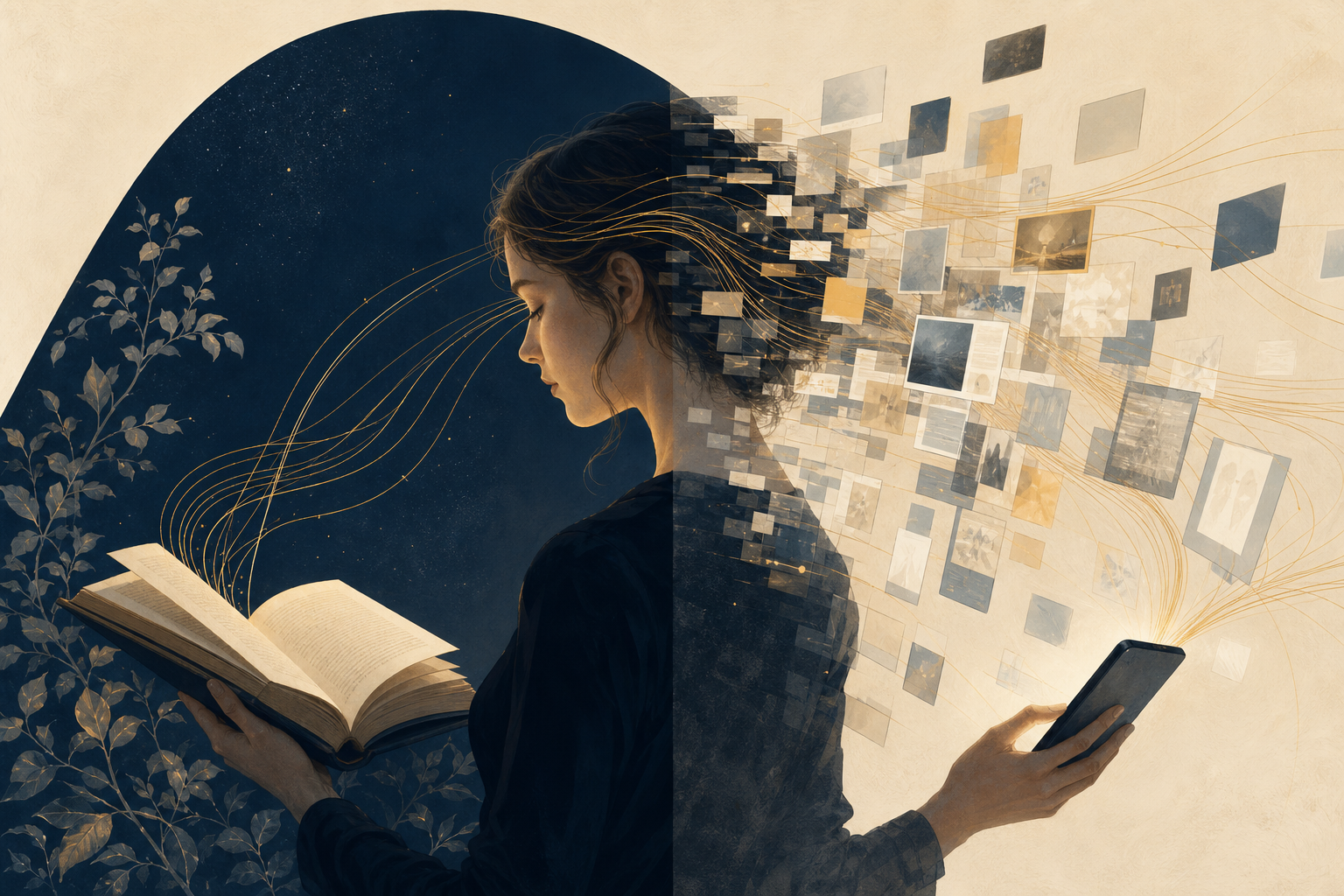
Most people do not need to be convinced that their attention has changed. They feel it. A chapter that once seemed inviting now feels long. A paragraph becomes a wall. The hand reaches for the phone before the mind has formed a reason. The problem is not that modern people no longer read; in one sense, we read more than ever. We read messages, feeds, headlines, captions, alerts, search results, and fragments all day.
The question is what kind of reading we are practicing.
Deep reading is slow, inferential, sustained, and cumulative. It connects sentences across pages, tests claims, builds mental models, and tolerates ambiguity. Skimming is fast, selective, and useful. It helps us locate information, triage relevance, and move efficiently. The danger is not skimming itself. The danger is when skimming becomes the default posture for every text.
Screens reward extraction
Digital reading environments are optimized for movement. Links invite departure. Notifications interrupt. Search encourages jumping directly to a term. Infinite scroll removes natural stopping points. Tabs create peripheral temptation. The device that holds the essay also holds email, messages, banking, maps, music, work, news, and entertainment.
This does not mean screens cannot support deep reading. They can. E-readers, distraction blockers, note apps, and well-designed reading modes can be excellent. But the dominant screen environment trains extraction: find the answer, sample the argument, scan for relevance, move on.
That posture is rational. If you are reading a search-results page, skimming is the correct strategy. If you are checking whether an article answers a practical question, skimming saves time. But the habit can leak. We begin to treat a philosophical chapter or serious historical essay like a webpage to mine for takeaways.
The bi-literate brain
Maryanne Wolf has argued that the future may require a “bi-literate brain”: one capable of both digital speed and print-like depth. This framing is useful because it avoids nostalgia. The goal is not to reject screens. The goal is to preserve multiple modes of attention.
Reading is plastic. The more we practice a mode, the more available it becomes. If most of our daily reading is fractured and goal-directed, sustained reading may feel awkward at first. The brain has not lost the capacity; it has become less practiced.
This helps explain why people often return to paper when the stakes are high. Many readers report better concentration, memory, or spatial orientation with printed books. Studies comparing print and screen comprehension are complex and vary by task, device, age, and genre, but a recurring pattern is that longer, expository, or conceptually demanding texts often benefit from paper or from screen environments that mimic paper’s stability.
Paper has affordances that are easy to overlook. A printed book has thickness. Progress is visible. Margins invite annotation. The text does not refresh. The page does not contain an inbox. These physical constraints reduce certain kinds of decision fatigue.
Deep reading is an ethical skill
It is tempting to think of deep reading as a productivity trick: read harder books, get smarter, win. But deep reading also has a moral dimension. To read carefully is to resist caricature. It means giving an author enough time to make a case before responding. It means noticing qualifiers, definitions, evidence, and structure.
Many public arguments collapse because people respond to headlines, clips, or fragments. Deep reading builds patience with context. It slows the rush from stimulus to judgment.
This does not mean all long texts deserve reverence. Some are bad, dishonest, or bloated. But careful reading gives criticism a stronger foundation. The fastest dismissal is not always the most intelligent one.
How to rebuild the muscle
The good news is practical: deep reading can be trained.
Start by separating modes. If you are skimming for information, skim deliberately. If you are reading for depth, remove the tools of skimming. Put the phone in another room. Use paper or a dedicated e-reader. Choose a time when your attention is not already shredded. Begin with twenty minutes, not two hours.
Annotate lightly. Mark questions, not just “important” lines. Summarize a section in your own words before moving on. If a sentence matters, copy it by hand. Reread the opening after finishing a chapter; good writers often plant the frame early.
Most importantly, tolerate the first ten minutes of restlessness. The mind expects novelty. It will protest. If you do not immediately obey, the turbulence often passes. Attention has a settling period.
Screens are not the enemy; default settings are
The future of reading will not be paper-only. Nor should it be. Digital archives are extraordinary. Search is powerful. Accessibility features can transform reading for people with visual, motor, or language difficulties. Hyperlinks can illuminate context. A phone can carry a library.
The problem is unchosen design. If every reading environment is built to maximize engagement, the reader must build counter-environments for depth. This is not a private failure of willpower. It is an architectural problem.
A serious reading life in the digital age therefore requires deliberate friction. Turn off notifications. Use read-later apps. Print difficult essays. Keep a physical book visible. Create a morning or evening reading slot before the feed has trained your tempo for the day.
Deep reading is not dead. But it is no longer the default cultural setting. It has to be chosen.
What we lose if we stop practicing
If we lose deep reading, we do not only lose long novels or difficult philosophy. We lose a form of thought that unfolds across time. Some truths cannot be compressed into a headline. Some arguments require patience. Some experiences demand immersion before they yield meaning.
Skimming gives us breadth. Deep reading gives us depth. A healthy mind needs both. The task is not to pick one forever, but to know which mode a text deserves — and to remain capable of entering it.
Further reading
- Maryanne Wolf, Reader, Come Home
- Nicholas Carr, The Shallows
- Anne Mangen and colleagues, research on reading comprehension across print and screen
- Naomi Baron, Words Onscreen
- Cal Newport, Deep Work