
The Secret Life of Bookstores
A bookstore is not only a shop. At its best, it is a filter, a stage, a local memory, a recommendation engine with a human face, and one of the last places where browsing remains a serious act.
DistilledReads ·
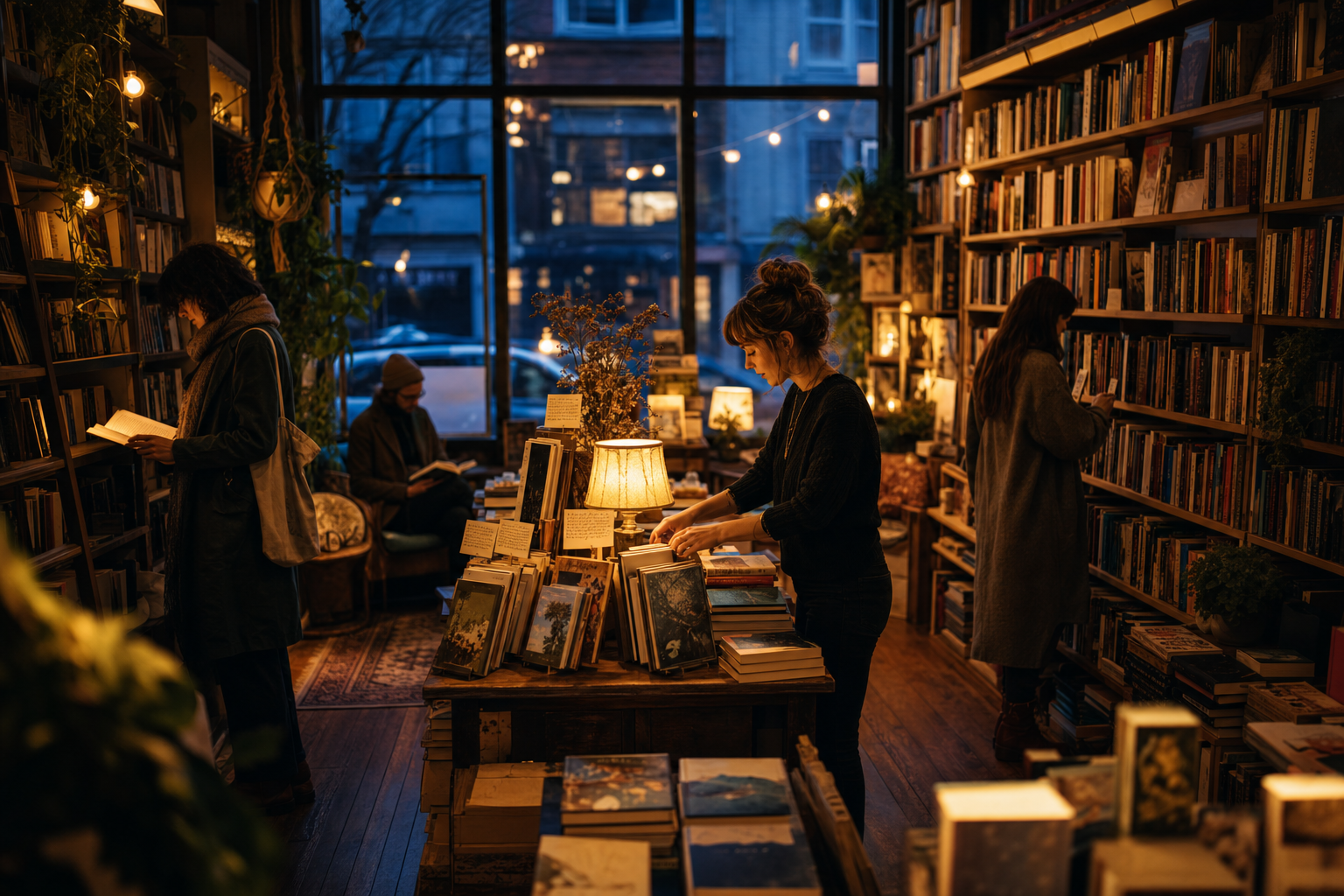
A bookstore looks simple from the outside: shelves, tables, cash register, maybe coffee, maybe a cat. But the best bookstores are doing a surprising amount of invisible work. They are sorting culture. They are staging encounters. They are preserving a neighborhood’s intellectual weather. They are making taste public.
Online stores are superb at inventory. They can carry almost everything and ship it quickly. A bookstore cannot compete with infinity. Its power comes from limitation. Every book on a table has displaced another book. Every staff pick is an argument. Every shelf is a theory of what might matter to the people who walk in.
That is why bookstores still matter. They are not warehouses. They are curated rooms.
Book markets before bookstores
The history of bookstores begins before the modern shop. Ancient cities had book dealers, copyists, and markets for scrolls. In Rome, books could be bought, copied, circulated, and displayed. In the Islamic world, booksellers’ quarters became centers of scholarship and exchange. In Edo Japan, booksellers and lending libraries helped create a vibrant urban reading culture.
The bookstore has always sat between commerce and culture. It sells objects, but those objects carry memory, argument, entertainment, status, and sometimes danger. A bookseller is therefore never merely moving units. They are helping decide which texts meet which readers.
This role expanded with print. As books became cheaper and more numerous, the problem changed from scarcity to selection. A reader did not only need access; a reader needed orientation. The bookseller became a guide through abundance.
Browsing as discovery technology
Search is powerful when you know what you want. Browsing is powerful when you do not.
In a bookstore, discovery happens through adjacency. A book on medieval libraries sits near a book on paper, which sits near a book on translation, which sits near a biography of a scholar you have never heard of. Your attention moves sideways. You encounter not only the answer to a question, but the possibility of a better question.
Algorithms recommend from patterns of past behavior. Bookstores can interrupt those patterns. A display table can introduce a theme you did not know you cared about. A bookseller can connect two unlike interests. A shelf can make a hidden field visible.
This is one reason physical browsing feels different from scrolling. The room has edges. The table has a surface. The pile is finite. You can exhaust a shelf, turn around, and be surprised by another one. The body participates in discovery.
The staff pick as miniature essay
A staff recommendation card may be only a few sentences, but it is one of the great small forms of literary culture. It says: a real person read this, cared enough to recommend it, and can tell you why.
That human risk matters. A five-star average tells you many people approved. A bookseller’s note tells you one particular mind is vouching for an experience. It may be wrong for you, but it is accountable in a way anonymous ratings are not.
The best recommendation is not “everyone loves this.” It is “given what you told me, you might love this.” Bookstores preserve that conversational intelligence.
Bookstores as local memory
Independent bookstores often become informal archives of place. They know the local authors, school reading lists, community debates, regional histories, neighborhood obsessions, and recurring customers. They host readings, book clubs, children’s hours, launches, memorials, fundraisers, and arguments.
A good bookstore learns its city. It knows which poetry sells in winter, which history shelf draws retired teachers, which children’s books grandparents ask for, which local memoir suddenly matters because a community is processing change.
This is a kind of knowledge no centralized platform can fully reproduce. It is not just data. It is relationship.
The economics are fragile
The romance of bookstores can obscure their difficulty. Margins are thin. Rent rises. Inventory is expensive. Returns, shipping, staffing, events, and online competition create constant pressure. Many beloved shops survive because owners and booksellers do more emotional and cultural labor than the business model fully rewards.
This does not make bookstores morally pure. They are businesses. They can be elitist, badly curated, unwelcoming, or financially unsustainable. But when they work, they create value that is larger than the transaction.
The public often discovers this only after losing one. A closed bookstore is not just one less place to buy books. It is one less room where reading had a physical address.
Why bookstores make readers braver
One of the subtle gifts of a bookstore is permission. A person can wander into philosophy without enrolling in a class. A teenager can discover queer literature away from family surveillance. A grieving spouse can stand before the death shelf without explaining. A new parent can ask for help. A bored person can become curious.
Bookstores make private transitions visible but not intrusive. They let people move toward new selves quietly.
This matters because reading is often aspirational. We buy books not only for who we are, but for who we hope to become. The bookstore is full of possible selves: cook, gardener, historian, poet, entrepreneur, parent, skeptic, believer, citizen, witness.
The future of the bookstore
Bookstores will not survive by pretending the internet does not exist. The strongest shops use online ordering, newsletters, events, social media, memberships, school partnerships, and careful community building. But their deepest advantage remains physical and human.
They offer friction in a culture of instant search. They make readers slow down. They place books into scenes: a table, a season, a conversation, a recommendation, a room.
That is the secret life of bookstores. They are not just places where books wait to be bought. They are places where readers are made more likely.
Further reading
- Lewis Buzbee, The Yellow-Lighted Bookshop
- Jorge Carrión, Bookshops
- Laura J. Miller, Reluctant Capitalists
- Shaun Bythell, The Diary of a Bookseller
- Henry Hitchings, Dr Johnson’s Dictionary (for the culture of eighteenth-century books and print)