The Library of Alexandria: How an Empire Tried to Hold Every Book
The Great Library was not simply a building full of scrolls. It was an imperial research program — an attempt to collect, edit, classify, and control the written memory of the Mediterranean world.
DistilledReads ·
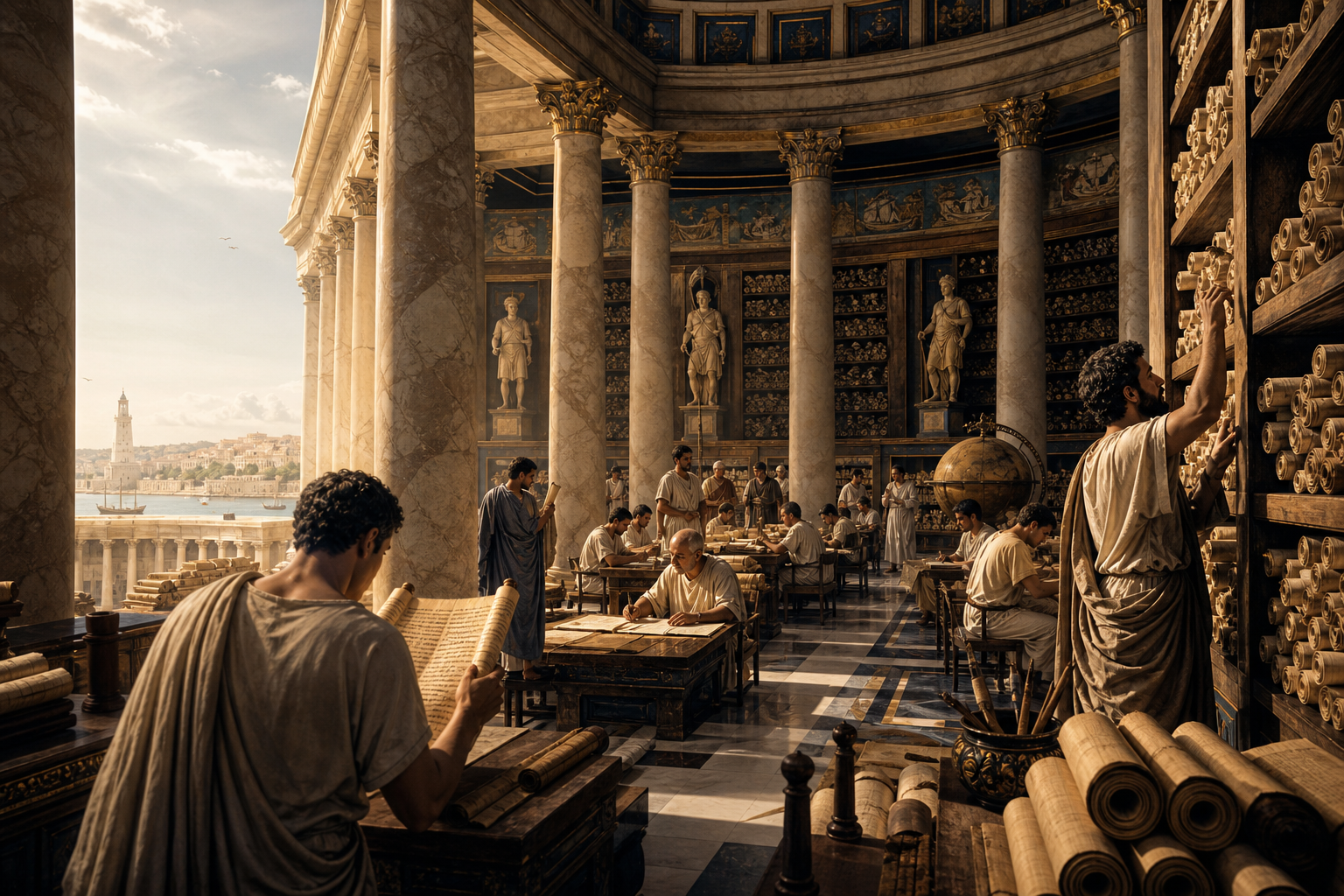
The Library of Alexandria occupies a strange place in cultural memory. It is half institution, half symbol. Ask people what was lost there and many will answer: everything. The accumulated wisdom of the ancient world, burned in a single catastrophic fire. That story is powerful, but it is also too neat.
The real Library was not a single magical room that vanished in one night. It was part of a broader scholarly complex in Ptolemaic Egypt, probably connected to the Mouseion, a state-supported community of scholars. Its decline was likely gradual, caused by war, politics, neglect, religious change, and shifting patronage. But the myth survives because it expresses something true: written knowledge is fragile, and civilization often realizes too late what it has failed to preserve.
To understand Alexandria, we have to see it not only as a library but as a geopolitical project.
A library built by kings
After Alexander the Great died in 323 BCE, his empire fractured. Egypt fell to Ptolemy I Soter, one of Alexander’s generals. The Ptolemies were Macedonian Greeks ruling over Egypt, a land with its own ancient religious, administrative, and scribal traditions. They needed legitimacy. Alexandria, founded by Alexander, became their showcase city: Greek, Egyptian, commercial, cosmopolitan, and strategically placed on the Mediterranean.
The Library served that ambition. It was not merely decorative. It announced that Alexandria would not only trade grain and command fleets; it would gather the world’s texts and become the center of learning.
Ancient sources differ, but the Library is often associated with Demetrius of Phalerum and the early Ptolemies. Scholars were housed, fed, and paid. They studied poetry, mathematics, astronomy, medicine, geography, grammar, and philosophy. The institution was closer to a research institute than a modern public library. Its readers were not ordinary citizens browsing shelves. They were elite scholars working with texts as objects of interpretation, correction, and comparison.
The age of scrolls
The Library’s books were not books in the modern sense. They were scrolls, usually made of papyrus: a writing material manufactured from the pith of the papyrus plant, cut into strips, pressed, dried, and polished. Papyrus was light and relatively portable, but it was also vulnerable to moisture, insects, handling, and time.
A long work often occupied multiple scrolls. To find a passage, a reader had to unroll and reroll, moving through the text linearly. The codex — folded leaves bound on one side, the ancestor of the modern book — would only become dominant centuries later. In Alexandria’s world, knowledge was rolled.
This physical format shaped scholarship. Cataloging mattered enormously. So did copying. A text did not survive by being written once. It survived by being recopied across generations. Every copy introduced the possibility of error, variation, correction, or intentional alteration. Ancient scholarship was therefore partly an art of textual repair.
Collecting the world
The Ptolemies pursued books aggressively. One famous story claims that ships arriving in Alexandria were searched for texts. Books were copied; the copy was returned, and the original was kept in the Library. Whether literally true in every detail or not, the story captures the institutional appetite: Alexandria wanted originals, variants, rare works, and complete collections.
The Library’s scholars edited Homer, classified Greek drama, studied language, and compared manuscripts. Callimachus, a poet and scholar, is associated with the Pinakes, a vast bibliographic catalog often described as one of the earliest major library catalogs. It classified authors and works by genre, biography, and textual details. In a world without search engines, a catalog was intellectual infrastructure.
This is easy to underestimate. A library is not simply a pile of texts. Without order, texts become inaccessible. Alexandria’s achievement was not only collecting but organizing.
What was lost?
The honest answer is: we do not know. Ancient estimates of the Library’s holdings range wildly, often into hundreds of thousands of scrolls. But a scroll is not a modern volume, and ancient numbers are frequently rhetorical. Some works existed in multiple copies. Some were parts of larger works. Some were duplicates, drafts, or commentaries.
The famous burning by Julius Caesar in 48 BCE may have destroyed books near the harbor, perhaps in warehouses, but ancient accounts do not clearly prove that the entire Library was consumed. Later damage may have occurred under Aurelian in the third century, when fighting damaged Alexandria’s royal quarter. The Serapeum, sometimes linked to a “daughter library,” was destroyed in the late fourth century amid Christian-pagan conflict. By the time Arab armies took Alexandria in the seventh century, the Great Library as a Ptolemaic institution was probably already gone.
This matters because the myth of one dramatic fire can obscure the more sobering truth: libraries often die slowly. Budgets disappear. Scholars leave. Catalogs stop being updated. Buildings decay. Political priorities change. The fragile chain of copying breaks.
Why Alexandria still matters
Alexandria represents an early recognition that knowledge is a form of power. To collect texts is to shape memory. To catalog them is to decide what categories matter. To edit them is to influence what later generations believe the text “really” was.
It also reveals the dependence of knowledge on institutions. We like to imagine ideas floating freely across time, but ideas need bodies: scribes, scholars, patrons, shelves, climates, trade routes, money, and peace. A brilliant work can vanish if no one copies it. A mediocre work can survive if copied often enough. The canon is not merely a judgment of quality; it is also a history of survival.
Finally, Alexandria asks a modern question: what are we preserving, and under what conditions? Digital abundance can make us complacent. We assume that because something is online, it is safe. But servers fail, formats rot, companies disappear, links break, and platforms change incentives. The Library of Alexandria is not only a warning about fire. It is a warning about stewardship.
Civilization is not what it once knew. It is what it manages to keep available.
Further reading
- Lionel Casson, Libraries in the Ancient World
- Luciano Canfora, The Vanished Library
- Roger Bagnall, “Alexandria: Library of Dreams”
- Mostafa El-Abbadi, Life and Fate of the Ancient Library of Alexandria
- Irene Vallejo, Papyrus