
How Children Become Readers
Children do not become readers merely by being handed books. They become readers through language, attention, instruction, imitation, access, confidence, and the discovery that print can belong to them.
DistilledReads ·
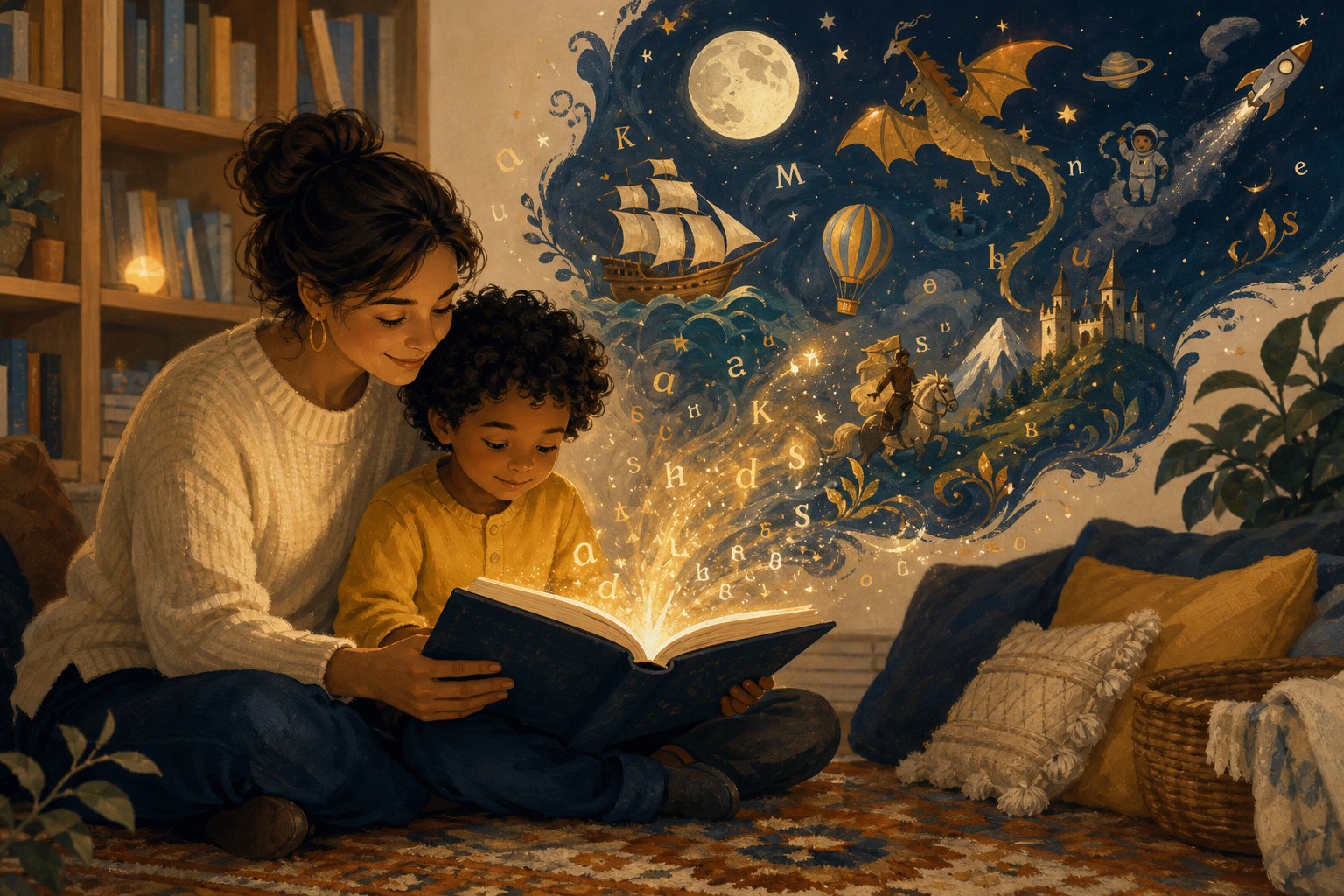
Children do not become readers in a single moment. The visible milestone — a child reading a sentence alone — is the result of many invisible preparations. Long before decoding, there is listening. Before fluency, there is language. Before independent reading, there is lap reading, pointing, rhyming, pretending, asking, memorizing, guessing, and watching adults treat books as objects worth returning to.
Reading is both a skill and an identity. A child must learn how print works, but also come to believe that reading is something people like them do.
Language comes first
Reading begins before print. Children who hear rich spoken language build vocabulary, syntax, background knowledge, and narrative expectations. They learn how stories work: beginning, problem, desire, sequence, surprise, resolution. They learn that words can describe things absent from the room.
Read-aloud time matters partly because of this language exposure. A picture book often contains vocabulary and sentence structures more complex than ordinary conversation. When an adult reads aloud, pauses, asks questions, points to pictures, and explains words, the child receives a guided tour through language.
This does not require expensive materials. It requires time, talk, repetition, and attention. A library card and a patient adult can do an astonishing amount.
Print must become code
At some point, children must discover that printed marks represent language. This is not obvious. A child may love stories, memorize books, and pretend to read without understanding the alphabetic principle: that letters and letter combinations map onto sounds.
For alphabetic languages, phonemic awareness and phonics matter. Children need to hear that words are made of sounds and learn how letters represent those sounds. This is the engine that allows them to read words they have never seen before.
The point is not to reduce reading to drills. The point is to give children the key to the system. Once decoding becomes reliable, the child is less dependent on memorization, pictures, or adult help. Independence begins.
Fluency changes the emotional experience
Early reading can be effortful and frustrating. If every word is a puzzle, a page feels like a hill. Fluency changes the emotional climate. The child can move through sentences smoothly enough to care about meaning.
This is why practice matters, but practice must be calibrated. Books that are too hard create exhaustion. Books that are too easy may not stretch. The best reading growth often happens in the “just right” zone: enough challenge to build skill, enough success to build confidence.
Repetition helps too. Adults may tire of the same book long before children do. But repeated reading supports fluency, prediction, vocabulary, and mastery. A child who “reads” a memorized book is not faking. They are participating in the rhythms of literacy.
Background knowledge makes comprehension possible
We often talk as if reading comprehension is a general skill. It is partly skill, but it is also knowledge. A child reading about volcanoes, baseball, ancient Egypt, or friendship understands more when they already know something about the topic.
This is why broad exposure matters. Museums, conversations, cooking, nature walks, maps, family stories, documentaries, and nonfiction books all feed comprehension. Knowledge compounds. The more a child knows, the easier new texts become.
Children who read widely gain not only vocabulary but worlds: animals, machines, emotions, history, geography, jokes, myths, jobs, rules, and possibilities. A book can make the next book easier.
Motivation is not a decoration
Adults sometimes treat motivation as secondary: first make the child read, then hope they like it. But motivation is part of the learning system. A child who wants to know what happens next will persist longer. A child who feels humiliated by reading will avoid it, and avoidance slows growth.
Choice matters. So does dignity. Comic books, joke books, sports biographies, fantasy series, animal facts, graphic novels, audiobooks, and rereading old favorites can all support a reading life. The question is not whether a book impresses adults. The question is whether it keeps the child in meaningful contact with language.
There is room for guidance and standards, but contempt is poison. A child who hears that their preferred reading “doesn’t count” may conclude that reading is a performance for adult approval rather than a source of pleasure and power.
The social life of reading
Children imitate what they see. A home can be full of books yet communicate that reading is homework, or it can have few books yet treat stories as treasured. Adults who read, talk about books, visit libraries, ask what a child is reading, and make time for quiet attention are teaching more than content. They are modeling a way of being.
Schools matter enormously, but they cannot do everything. Libraries matter because they lower the cost of access and make reading public. Book fairs, classroom libraries, family read-alouds, neighborhood story times, and older siblings reading to younger ones all widen the circle.
Reading is often described as solitary. For children, it is deeply social before it becomes solitary.
Struggle should be met early and seriously
Some children do not “catch up” simply by waiting. Dyslexia, language delays, hearing issues, vision problems, attention difficulties, and gaps in instruction can all interfere. Early, evidence-based support is not labeling a child as broken. It is removing unnecessary suffering.
The longer reading failure persists, the more emotional weight it gains. A child may begin with a decoding problem and end with a belief: “I am not a reader.” That belief is costly.
Good intervention protects identity as well as skill. It says: this is hard because your brain needs a different route, not because you are stupid. We can build the route.
When reading becomes identity
At some point, if things go well, reading shifts from assignment to agency. The child reads to find out, to feel brave, to laugh, to escape, to master a subject, to join a fandom, to be alone, to be with others, to become someone.
That is the real threshold. Not the first decoded word, though that is beautiful. The deeper threshold is when a child discovers that books are not only things adults value. They are tools the child can use.
To help children become readers, we need the whole ecology: language-rich homes and classrooms, explicit instruction, abundant books, patient adults, libraries, choice, support for struggle, and a culture that treats reading as both practical and joyful.
A child who becomes a reader has not simply learned a school skill. They have gained a private door into the larger human conversation.
Further reading
- Maryanne Wolf, Proust and the Squid
- Daniel T. Willingham, The Reading Mind
- Mark Seidenberg, Language at the Speed of Sight
- Jim Trelease, The Read-Aloud Handbook
- Emily Hanford, “Sold a Story”