The History of Libraries: From Clay Tablets to Public Knowledge
Libraries began as instruments of power: storehouses for taxes, laws, omens, contracts, and royal memory. Over time, they became one of civilization's boldest promises — that knowledge should outlive its moment.
DistilledReads ·
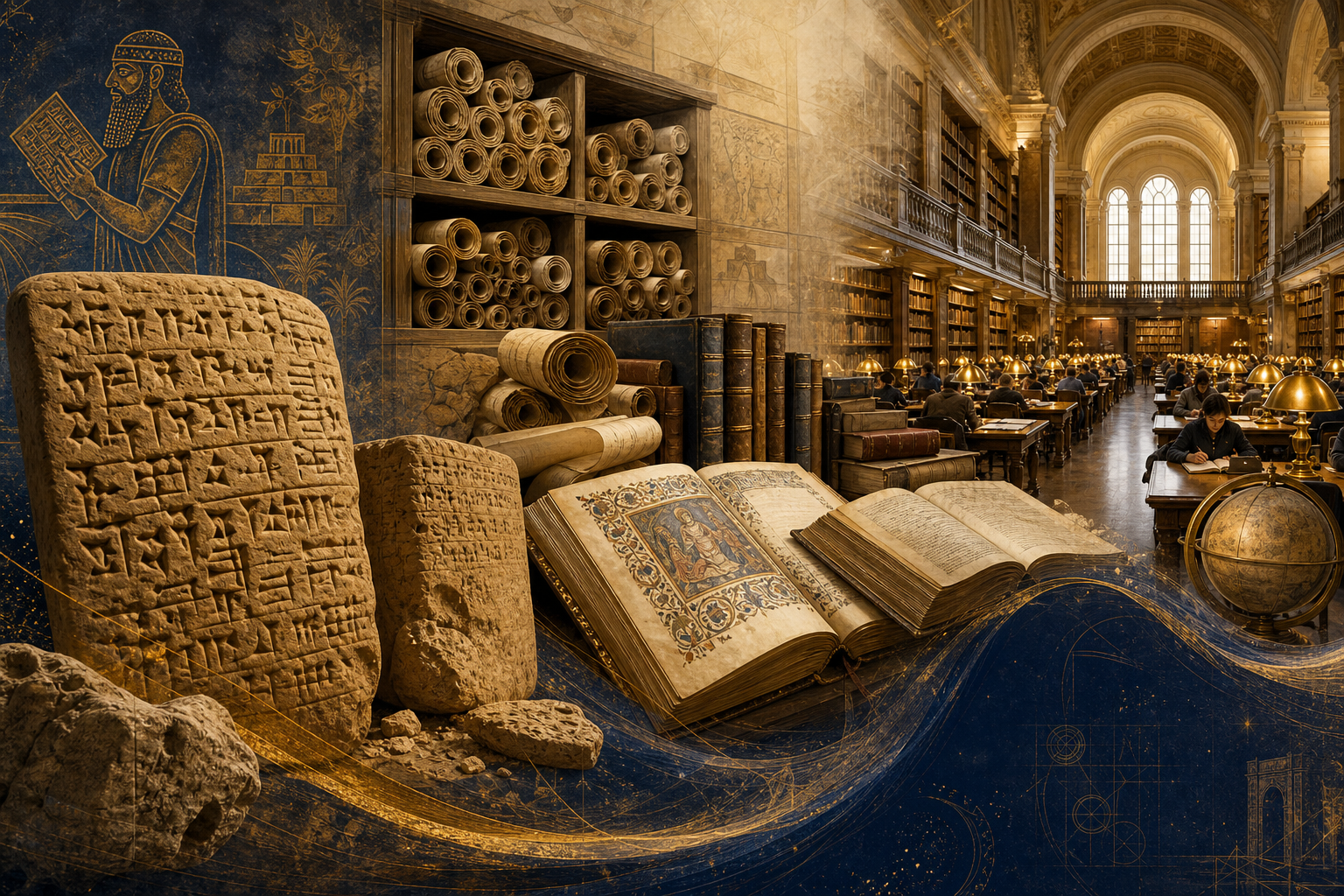
Libraries did not begin as quiet rooms for curious citizens. They began as tools of administration and power. The earliest collections of writing were not novels or essays, but records: grain, taxes, debts, laws, contracts, treaties, rituals, omens, and royal decrees. Before a library could be a public good, it was a way for states, temples, and palaces to remember what ordinary human memory could not hold.
That origin matters. A library is never just a pile of texts. It is a claim about what deserves preservation, who may access it, and what kind of future the present imagines. Every library, from a clay tablet archive to a modern public branch, is a political and moral structure disguised as shelves.
Clay, bureaucracy, and the first archives
Writing emerged in ancient Mesopotamia partly because complex societies needed durable records. Clay tablets were practical: wet clay could be impressed with a reed stylus, dried, stored, and, when necessary, baked hard by accident or design. Many tablets that survive today did so because fires destroyed buildings but hardened the clay.
The great library of Ashurbanipal at Nineveh, assembled in the seventh century BCE, is one of the most famous ancient collections. It included royal inscriptions, lexical lists, medical texts, omen series, hymns, myths, and the epic material we now associate with Gilgamesh. But calling it a “library” in the modern public sense can mislead. It was royal, scholarly, priestly, and administrative. It served palace knowledge.
Still, something profound happened there. Texts were collected not only for immediate use but for continuity. Scribes copied older works, organized them, and preserved intellectual traditions across generations. The library became a technology for extending cultural time.
Alexandria and the dream of total collection
The Library of Alexandria represents a different ambition: not merely to preserve a kingdom’s records, but to gather the world’s books. Under the Ptolemies, Alexandria became a state-backed research center, linked to scholars, cataloging, editing, and textual criticism.
Its fame rests partly on myth. We do not know exactly how many scrolls it held, how it declined, or how much was lost in particular fires. But the symbolic force remains: Alexandria imagined knowledge as something that could be collected, ordered, and made central to imperial prestige.
This was a turning point in the idea of a library. It was not just memory storage. It was an intellectual engine. Scholars compared manuscripts, edited Homer, classified works, and built catalogs. A catalog may seem mundane, but without it a library is chaos. Classification is the act by which abundance becomes usable.
Monastic libraries and the survival of texts
After the decline of the western Roman Empire, monasteries became crucial sites of textual preservation in Europe. Monastic libraries were not neutral warehouses of everything; they were shaped by religious priorities. Scripture, commentaries, liturgy, theology, grammar, and selected classical works received attention. Many pagan texts survived because monks copied them. Many others vanished because no institution found enough reason to keep copying them.
The scriptorium — whether an actual dedicated room or a broader copying practice — turned preservation into labor. A manuscript book required animal skins or paper, ink, ruling, copying, correction, binding, and often decoration. Books were expensive enough to be chained to shelves. A library was a treasure house.
This era teaches a humbling lesson: preservation is selective. We inherit not “the past” but the past that survived institutions, accidents, climates, wars, interests, and copying choices.
Islamic libraries and the culture of paper
The spread of paper through the Islamic world transformed library culture. Baghdad, Cairo, Cordoba, Nishapur, and other centers supported scholars, copyists, booksellers, and readers. Libraries attached to mosques, madrasas, hospitals, courts, and private homes became part of a rich intellectual ecology.
Paper made books more abundant than parchment cultures could easily support. Translation, commentary, medicine, astronomy, law, poetry, philosophy, and theology all benefited. The library was not merely a storage place; it was embedded in teaching, debate, and transmission.
Islamic library culture also reminds us that the public/private divide is too simple. A ruler’s library might support scholars. A mosque collection might serve students. A private collection might circulate through networks. The boundaries between personal devotion, professional study, and public knowledge were porous.
University and civic libraries
Medieval universities created new demands for books. Students needed texts. Teachers needed authorities. Legal, theological, medical, and philosophical study depended on reference. Libraries increasingly supported institutional learning.
With printing, the economics changed again. Books multiplied. Collections grew. Catalogs became more important. The library’s mission shifted from guarding rare manuscripts to managing printed abundance.
By the early modern and modern periods, civic and national libraries began to embody broader claims: that a city, nation, or public had a stake in preserving knowledge. Legal deposit systems required publishers to submit copies. National libraries became cultural memory machines. They collected not only revered classics but pamphlets, newspapers, maps, music, ephemera, and the ordinary printed evidence of a society’s life.
The public library as a democratic idea
The modern public library is one of the most radical institutions ever normalized. It says: you may enter without buying anything; you may read beyond your class; you may borrow what you cannot afford; your curiosity is legitimate.
In the United States and Britain, nineteenth- and twentieth-century public library movements were tied to education, civic improvement, philanthropy, industrialization, and democracy. Carnegie libraries are the most famous symbol, but they were part of a larger transformation. The library became an infrastructure of self-education.
Public libraries are often described sentimentally, but their importance is practical. They provide books, internet access, children’s programming, job resources, quiet space, archives, community rooms, and help navigating information systems that can be hostile to the poor, elderly, young, or overwhelmed.
A public library is not just a collection. It is a social promise.
Digital libraries and the new fragility
Today, much of the world’s text is searchable. This feels like the final victory of the library idea: access everywhere, instantly. But digital abundance has new fragilities. Files depend on formats, licenses, servers, electricity, companies, search ranking, and legal regimes. A book you “own” digitally may be licensed. A database can disappear. A link can rot. A platform can change its terms.
The library’s task is therefore not obsolete. It may be more important. Librarians now preserve born-digital materials, negotiate database access, teach information literacy, maintain archives, and defend privacy. They help people tell the difference between availability and reliability.
Search is not the same as stewardship. The internet is vast, but not all of it is cared for.
What libraries have always known
Across their history, libraries have balanced four tensions:
- preservation and access
- authority and freedom
- abundance and order
- memory and use
Too much preservation without access turns the library into a tomb. Too much access without preservation turns it into a passing feed. Too much authority becomes control. Too little order becomes noise.
The best libraries are living institutions. They keep the dead available to the living. They let a child encounter a book no one in the house could afford. They let a scholar verify a citation. They let a city remember itself. They let a private reader discover that the world is larger than the room they came from.
Libraries began as instruments of power. At their best, they became instruments of possibility.
Further reading
- Matthew Battles, Library: An Unquiet History
- Lionel Casson, Libraries in the Ancient World
- Alberto Manguel, The Library at Night
- Wayne A. Wiegand, Part of Our Lives
- Ann Blair, Too Much to Know