Forbidden Books: What Censorship Reveals About the Power of Reading
A banned book is rarely just a book. It is a sign that someone believes words can change loyalties, unsettle authority, awaken desire, preserve memory, or make obedience harder.
DistilledReads ·
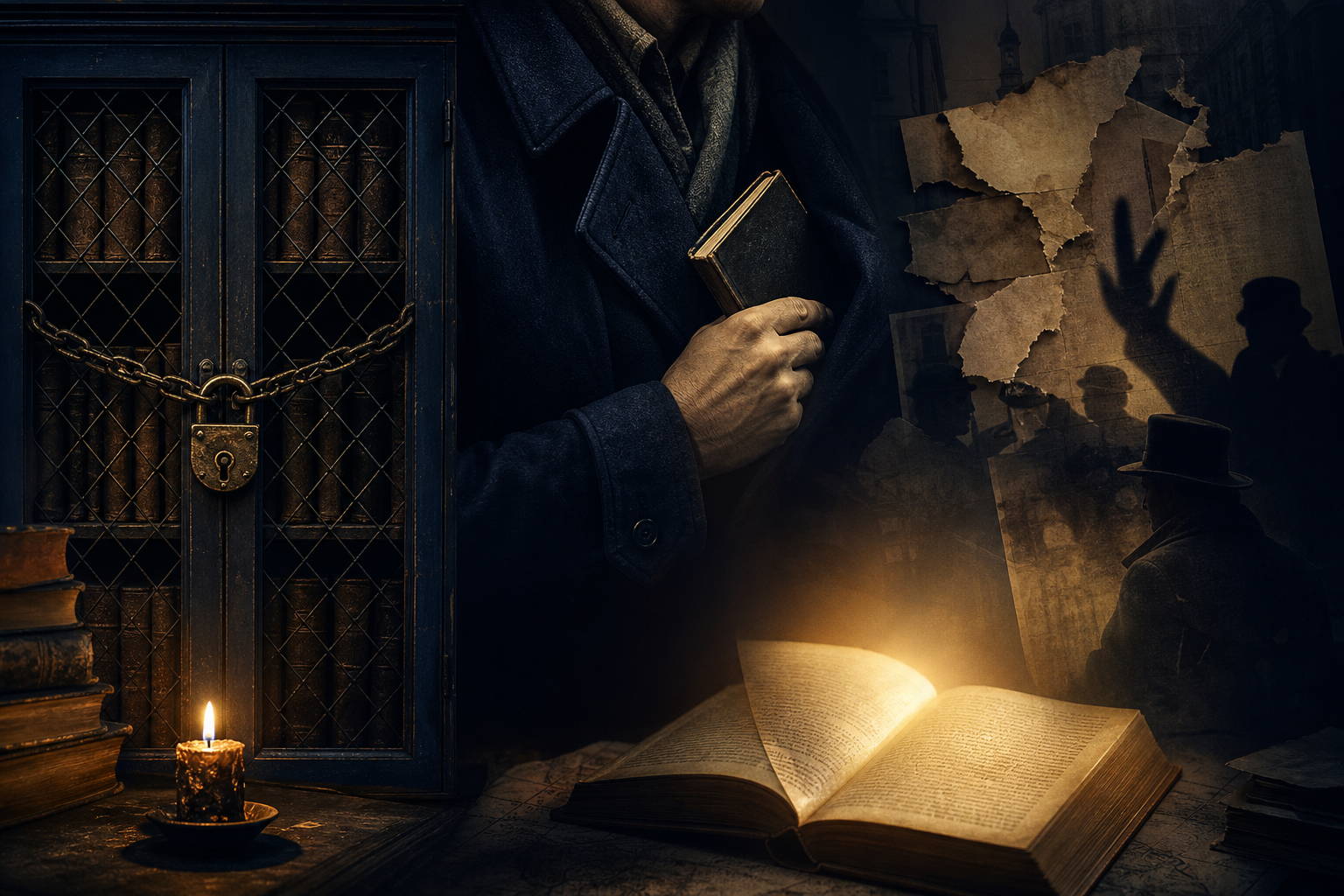
People do not censor books because paper is dangerous. They censor books because reading can rearrange the mind of the reader. A book can preserve a forbidden memory, dignify a despised group, expose a contradiction, teach a method, name an injustice, awaken a desire, or make obedience feel less natural.
That is why the history of banned books is also a history of fear. Not always irrational fear — some books do change societies. But censorship reveals what authorities, institutions, parents, churches, parties, and communities believe they cannot survive being said.
A banned book is rarely just a book. It is a diagnostic instrument. It shows where power feels vulnerable.
Control begins with the archive
Book control is older than print. Ancient rulers destroyed inscriptions, erased names, burned records, and rewrote public memory. To control texts is to control continuity. If a king’s enemies vanish from the record, future generations inherit a curated past.
This is one reason libraries and archives have always been politically charged. They preserve evidence. Evidence can become accusation. A state that wants monopoly over memory must decide which documents may survive and which must disappear.
The destruction of books often accompanies conquest, religious conflict, revolution, and regime change. It is not only about ideas in the abstract. It is about institutional memory: laws, rituals, genealogies, maps, languages, scriptures, and histories.
To burn a book is to attack a chain of transmission.
The printed page multiplies the problem
Before print, suppressing a text was difficult but plausible if copies were scarce. Printing made censorship both more urgent and more difficult. A pamphlet could be produced quickly, carried secretly, translated, reprinted, and read aloud. Ideas acquired speed.
Early modern Europe responded with licensing systems, printers’ guild controls, church indexes, state privileges, and prosecutions. The Catholic Church’s Index Librorum Prohibitorum attempted to guide and restrict what Catholics could read. Protestant and secular authorities censored too. No side had a monopoly on suppression.
The press made authority anxious because it separated speech from place. A preacher could be watched. A manuscript could be seized. A printed tract could travel farther than its author and outlive the punishment of its printer.
Censorship as confession
Every act of censorship makes an unintended confession: this text might matter. Sometimes censorship backfires by giving a work glamour. The forbidden book becomes more desirable because someone has declared it potent.
But it would be naive to say censorship always fails. Many suppressed texts do disappear. Many writers are silenced. Many readers never encounter what might have changed them. The romance of forbidden reading should not obscure the cost borne by people who risk imprisonment, exile, poverty, violence, or death to write, print, hide, or circulate texts.
The courage of readers under censorship is not aesthetic. It is practical and dangerous.
Samizdat and the underground life of books
In the Soviet Union and other authoritarian contexts, unofficial texts circulated through samizdat: self-published, hand-copied, typed, photographed, or otherwise reproduced outside official channels. A poem, essay, novel, or testimony might pass from reader to reader, acquiring errors, annotations, and risk.
Samizdat reveals something essential about reading: access can become solidarity. To possess a forbidden text is not merely to own information. It can mean joining an unofficial public, a community of people who know the official story is not the only story.
This is why authoritarian regimes fear literature as well as journalism. A report can expose facts. A novel can preserve moral perception. It can show what fear feels like from the inside. It can make private compromise visible.
The school ban and the family fight
Not all censorship is state censorship. Many book challenges happen in schools and libraries. Parents and local groups object to sexual content, political ideology, racism, profanity, violence, religion, gender, or depictions of trauma. Some objections are cynical. Others are sincere. The debate is difficult because children are involved, and communities disagree about what protection means.
It is possible to believe in age-appropriate curation without endorsing broad suppression. A school library is not obligated to contain everything. But the line between selection and censorship depends on process, transparency, scope, and motive. Removing a book because it is poorly suited to a grade level is different from removing it because it acknowledges a kind of person a community would rather not discuss.
The key question is often: are we guiding children toward maturity, or shielding adults from discomfort?
Why regimes fear readers
Reading creates private space. Even in a crowded room, a reader can be elsewhere, thinking with another mind. This privacy is hard to police. A person may outwardly conform while inwardly comparing, doubting, remembering, or imagining alternatives.
Books also create time-depth. They let the dead speak, the exiled return, the defeated testify, and the future be imagined before it is permitted. A regime can control newspapers today and still fear novels from fifty years ago.
This is why tyrannies often prefer not only censorship but replacement: official histories, approved classics, patriotic schoolbooks, slogans, rewritten curricula. The goal is not silence alone. It is substitution.
The reader’s responsibility
Defending the freedom to read does not mean every book is good, true, harmless, or worth attention. Some books are hateful. Some are manipulative. Some are stupid. Some contain dangerous errors. Freedom of reading requires better criticism, not less.
The mature alternative to censorship is not passive consumption. It is argument, context, counterspeech, education, and trust in readers to grow through difficulty. A free reading culture must be capable of saying both “this book should not be banned” and “this book is wrong.”
That distinction is essential. If we cannot distinguish availability from endorsement, public life becomes brittle.
What forbidden books teach
Banned books teach us that reading is not ornamental. It matters enough to frighten people. It can make someone disobedient, but also more compassionate. It can unsettle prejudice, but also spread it. It can preserve truth, but also propaganda. Books are powerful because minds are powerful, and minds are never fully controllable.
The answer to dangerous reading is not obedient ignorance. It is stronger reading: historically informed, morally serious, evidence-seeking, open to discomfort, and capable of judgment.
When someone wants a book removed, ask what kind of reader they fear. A disloyal one? A confused one? A wounded one? A free one? The answer will often tell you more about the censor than about the book.
Further reading
- Azar Nafisi, Reading Lolita in Tehran
- Jonathan Rose, The Intellectual Life of the British Working Classes
- Robert Darnton, Censors at Work
- George Orwell, “The Prevention of Literature”
- PEN America reports on book bans and literary freedom