
Why Reading Fiction Makes You More Empathetic
A novel is not a lecture in kindness. It is a simulator for human interiority: a quiet machine for practicing what other people might think, feel, hide, and misunderstand.
DistilledReads ·
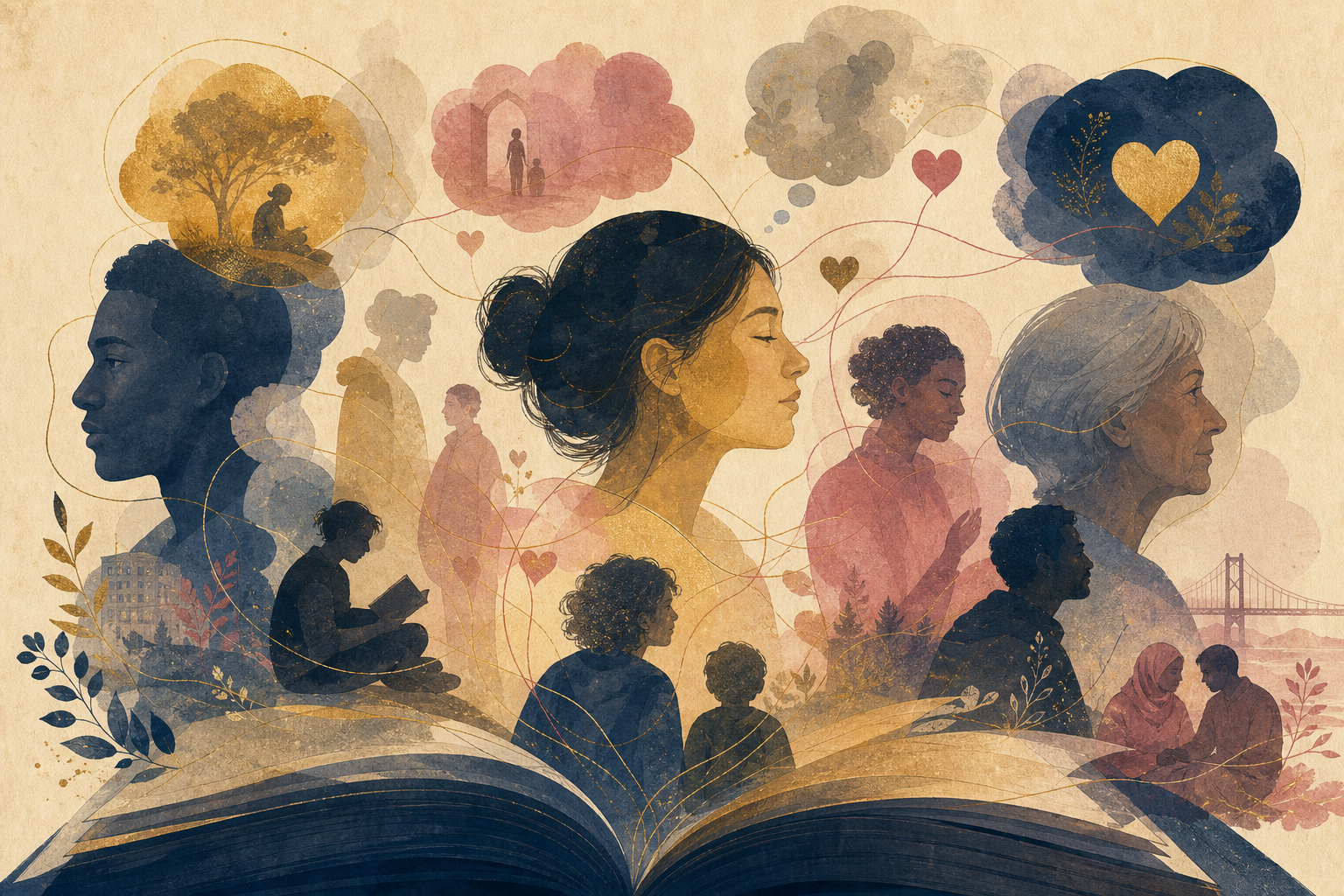
People often defend fiction by saying it is entertaining, beautiful, or culturally important. All true. But fiction may also be one of the best tools humans have invented for practicing a difficult social skill: imagining the inner lives of other people.
Everyday social life requires inference. We rarely know what someone else is thinking directly. We watch a face, hear a sentence, remember a pattern, and guess. Is the friend being quiet because she is angry, tired, distracted, or afraid? Did the colleague interrupt because he is rude, excited, insecure, or unaware? The human mind is constantly modeling other minds.
Psychologists often call this capacity “theory of mind.” Fiction trains it in a strange and powerful way. A novel can place us inside a consciousness that is not ours and make us care about its contradictions. We see not only what a character does, but what they notice, suppress, rationalize, misread, desire, and regret.
Fiction is not just “made-up events”
The most interesting part of fiction is not that imaginary things happen. It is that imaginary things happen to people with motives. Plot gives us sequence; character gives us interpretation. Without character, even the most dramatic event becomes thin.
Consider a simple sentence:
She did not answer the letter.
In nonfiction, we might ask for evidence: What letter? When? Did it arrive? In fiction, the sentence immediately opens inward. Was she afraid? Proud? Ill? Punishing someone? Protecting herself? Fiction invites the reader to inhabit ambiguity rather than eliminate it too quickly.
This is one reason good fiction often resists moral laziness. A flat villain may be satisfying, but a complex antagonist makes us do harder work. We may still judge the character, but we are asked to understand the path by which a person became capable of those choices. That difference — understanding without excusing — is one of the foundations of mature empathy.
The research is suggestive, not magic
Researchers such as Keith Oatley, Raymond Mar, and others have explored links between fiction reading and social cognition. Some studies suggest that frequent readers of literary fiction perform better on tasks that require interpreting others’ mental states. A famous 2013 paper by David Kidd and Emanuele Castano found short-term improvements after reading literary fiction, though later replication debates have made the story more complicated.
The safe conclusion is not “read a novel and become a better person.” Literature does not work like a vitamin. People can read deeply and remain cruel. They can love books and misunderstand their neighbors. But the research aligns with a plausible mechanism: fiction gives us repeated exposure to social complexity.
Unlike real life, fiction slows the scene down. It lets us examine the gap between intention and action. It shows how a person can mean one thing, say another, and be heard as a third. It reveals how memory distorts the present. It lets us watch shame, envy, loyalty, grief, pride, and tenderness from the inside.
Narrative transport lowers the drawbridge
One reason stories persuade is that they do not begin as arguments. An argument often triggers defense: Do I agree? Who is saying this? What tribe is it from? A story can bypass some of that resistance by inviting attention before demanding judgment.
Narrative transportation — the feeling of being absorbed into a story world — changes how we process information. When we are immersed, we are less likely to counterargue every sentence and more likely to simulate the experience. This does not mean stories are always good; propaganda uses narrative too. But it helps explain why novels can move people where essays sometimes cannot.
When a reader enters a story about migration, war, disability, childhood, poverty, ambition, or loneliness, the experience is not the same as receiving statistics. Statistics scale; stories specify. A number can tell us how many people are affected. A story can make us feel what one life is like from the inside.
Good moral imagination needs both. Stories without facts can become sentimental. Facts without stories can become abstract. Fiction’s gift is particularity.
Fiction expands the self without erasing it
One of the odd pleasures of reading fiction is being yourself and not yourself at the same time. You remain in your chair, in your room, in your life. Yet part of your attention is living elsewhere. You borrow a mind.
This borrowedness matters. In everyday life, empathy is often limited by proximity. We find it easier to care about people who resemble us, live near us, speak our language, or share our concerns. Fiction can widen that circle. It can make distant lives emotionally available.
But the best fiction does not simply ask us to identify. It also asks us to tolerate difference. A character may be morally alien, historically distant, or psychologically uncomfortable. The reader’s task is not always to say, “This is me.” Sometimes it is to say, “This is not me, and yet I can understand something true here.”
That is a more demanding form of empathy. It does not collapse others into ourselves. It lets them remain other.
The danger of instrumentalizing literature
There is a risk in talking about fiction as empathy training: we may reduce art to usefulness. A novel does not need to justify itself by improving social cognition. Beauty, pleasure, language, form, surprise, and play are enough.
Still, the usefulness is real. The point is not to turn literature into medicine but to notice that certain kinds of pleasure are also formative. We are shaped by what we attend to. A reader who spends years entering other minds may become more alert to the hiddenness of people in ordinary life.
After enough fiction, you may catch yourself hesitating before a quick judgment. You may wonder what information is missing. You may suspect that a stranger’s behavior has a history. You may become less certain that your first interpretation is the only one.
That hesitation is not weakness. It is often wisdom.
Reading other minds, then returning to the world
The final test of fiction is not whether it makes us feel noble while reading. It is whether it changes how we return. The best novels send us back to ordinary life with sharper perception: the pause before someone answers, the sentence someone repeats too often, the story a family tells about itself, the way a person protects a wound by turning it into a joke.
Fiction makes the invisible visible for a while. Then we have to decide what to do with that vision.
Further reading
- Keith Oatley, Such Stuff as Dreams
- Raymond Mar, research on fiction and social cognition
- David Comer Kidd and Emanuele Castano, “Reading Literary Fiction Improves Theory of Mind”
- Martha Nussbaum, Poetic Justice
- Lisa Zunshine, Why We Read Fiction