
Edo Japan's Reading Revolution: How a Closed Country Became a Nation of Readers
Long before modern mass media, Tokugawa Japan built a vibrant print culture of woodblock books, lending libraries, manuals, poetry, satire, theater, and popular fiction.
DistilledReads ·
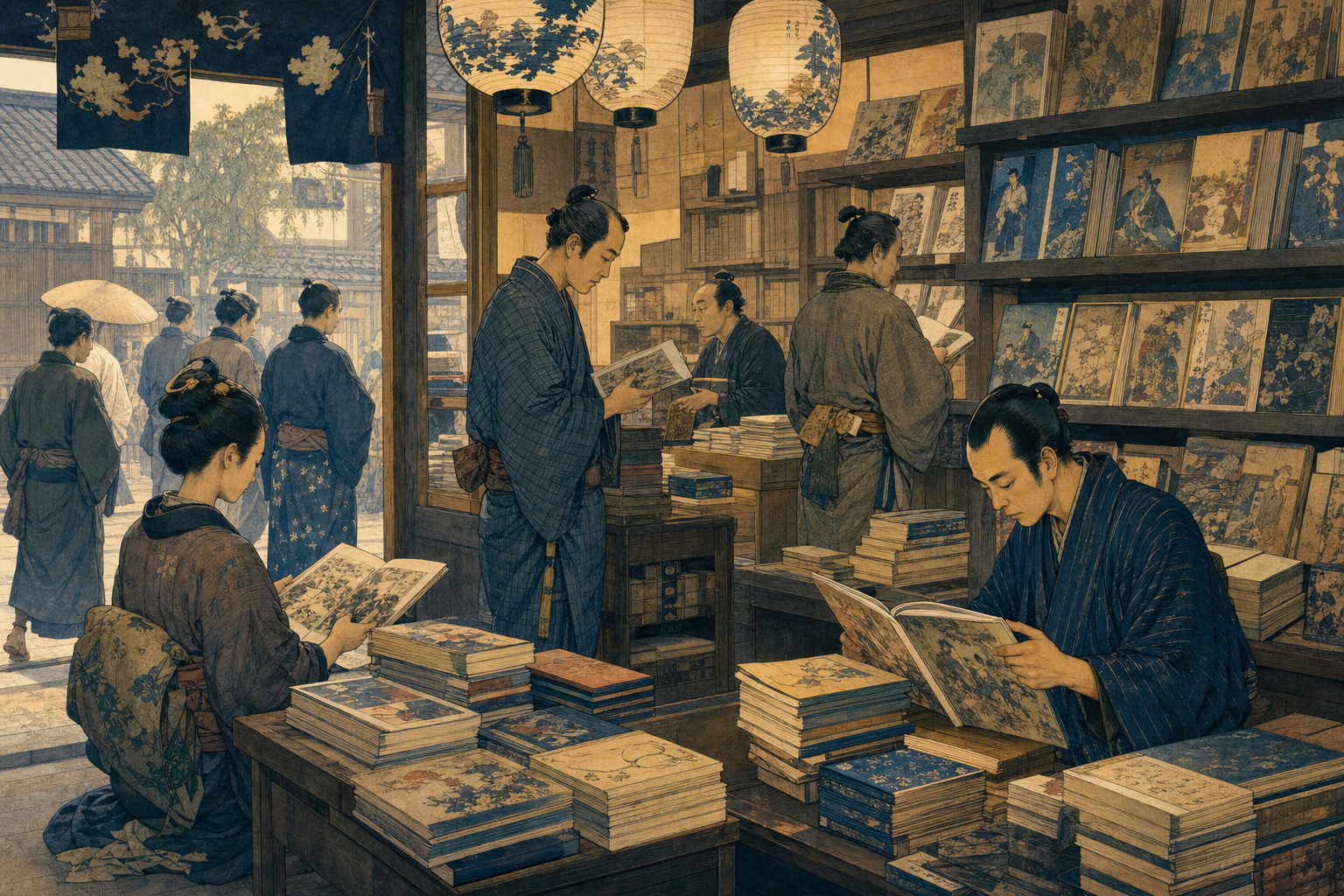
When people imagine early modern reading revolutions, they often think of Europe after Gutenberg. But Tokugawa Japan developed its own remarkable book culture, one built less on movable type than on woodblock printing, urban markets, education, and lending libraries. By the eighteenth and nineteenth centuries, Edo (today’s Tokyo), Osaka, and Kyoto supported a dense ecosystem of publishers, booksellers, illustrators, writers, teachers, and readers.
Japan under the Tokugawa shogunate (1603–1868) is sometimes described as “closed,” but that word can mislead. The regime restricted foreign relations, especially after the 1630s, but internally the country experienced urban growth, commercial expansion, and extraordinary cultural production. Books were part of that world.
Woodblock printing and the page as image
Japanese publishers relied heavily on woodblock printing. A text or image was carved into a wooden block, inked, and pressed onto paper. Movable type existed in Japan, but woodblocks were well suited to Japanese writing, which combined kanji and kana, and to illustrated works where text and image shared the page.
This produced a distinctive visual book culture. Books could be beautiful, playful, serialized, and image-rich. The same techniques that supported ukiyo-e prints also supported illustrated fiction, guidebooks, actor prints, erotic books, poetry collections, maps, manuals, and popular encyclopedias.
Woodblock printing had economic advantages too. Once a block was carved, copies could be produced when demand appeared. Blocks could be stored and reused. Publishers could issue editions, sequels, and variants. The book became both commodity and art object.
Literacy beyond elites
Tokugawa literacy was uneven by region, class, and gender, but it was impressive by early modern standards. Samurai needed literacy for administration. Merchants needed numeracy and writing for business. Villagers used documents for land, taxes, contracts, and community affairs. Urban commoners consumed entertainment literature.
One important institution was the terakoya, local schools often serving commoner children. They taught reading, writing, and arithmetic, frequently through copybooks and practical texts. Education was not universal in the modern sense, but it was widespread enough to create a broad reading public.
This is crucial: print culture does not grow from presses alone. It requires readers. Japan’s reading revolution was built on education, commerce, and the social usefulness of literacy.
Lending libraries and circulating books
Books were not always cheap, but readers did not always need to own them. Edo Japan had commercial lending libraries known as kashi-hon-ya. These businesses rented books to readers, expanding access and creating a circulating market for popular literature.
The lending-library model matters because it changes the social geography of reading. A book can pass through many hands. Readers can sample genres. Popular demand becomes measurable. Writers and publishers can respond to audiences. Reading becomes less a private luxury and more a shared urban habit.
The effect resembles later circulating libraries in Europe, which helped expand novel reading. Ownership is not the only path to literacy culture. Circulation can be just as important.
What did people read?
The range was wide. There were Confucian texts, Buddhist works, military tales, medical manuals, travel guides, farming manuals, poetry, kabuki-related publications, comic fiction, illustrated books, maps, and etiquette guides. Popular genres such as ukiyo-zōshi, kusazōshi, and later yomihon offered entertainment, satire, moral drama, and fantasy.
The floating world of urban pleasure quarters and theater generated its own print ecosystem. Readers bought or rented books that connected them to actors, courtesans, fashions, jokes, scandals, and city life. Print helped create celebrity culture.
At the same time, practical print flourished. Manuals taught everything from agriculture to letter-writing. This mixture of pleasure and utility is typical of real reading cultures. People read to be saved, entertained, instructed, amused, improved, employed, and included.
Censorship and creativity
The Tokugawa authorities censored print, especially works that threatened political order, criticized officials, or violated moral regulations. Censorship shaped what publishers dared to print. But readers and writers found indirect methods: allegory, historical disguise, humor, implication, and genre convention.
This pattern appears across print cultures. Control rarely eliminates expression; it changes its strategies. Readers learn to read between lines. Writers learn to encode. Publishers learn to calculate risk.
Edo print culture was therefore not simply free abundance. It was a negotiated space between market, authority, taste, and creativity.
A culture ready for modernity
When Japan entered the Meiji period after 1868, it did not become literate from scratch. It already had deep traditions of education, publishing, commercial circulation, and textual engagement. Modern newspapers, magazines, textbooks, and novels grew from an existing print ecology.
This is one reason Edo Japan matters for the history of reading. It shows that a highly literate, commercially vibrant book culture can develop through technological and institutional pathways different from Europe’s. Gutenberg is not the only story.
Books do not spread because a machine exists. They spread when materials, education, markets, genres, social aspiration, and pleasure align. Edo Japan aligned them in its own way, producing a society where reading was woven into business, entertainment, devotion, education, and urban identity.
The result was not just more books. It was more kinds of readers.
Further reading
- Peter Kornicki, The Book in Japan
- Mary Elizabeth Berry, Japan in Print
- Laura Moretti, Pleasure in Profit
- Sumie Jones, An Edo Anthology
- Amy Stanley, Stranger in the Shogun’s City