
The Islamic Golden Age and the Translation Movement of Baghdad
In Abbasid Baghdad, books became instruments of empire, scholarship, medicine, astronomy, philosophy, and faith — helped by paper, patronage, and a culture of translation.
DistilledReads ·
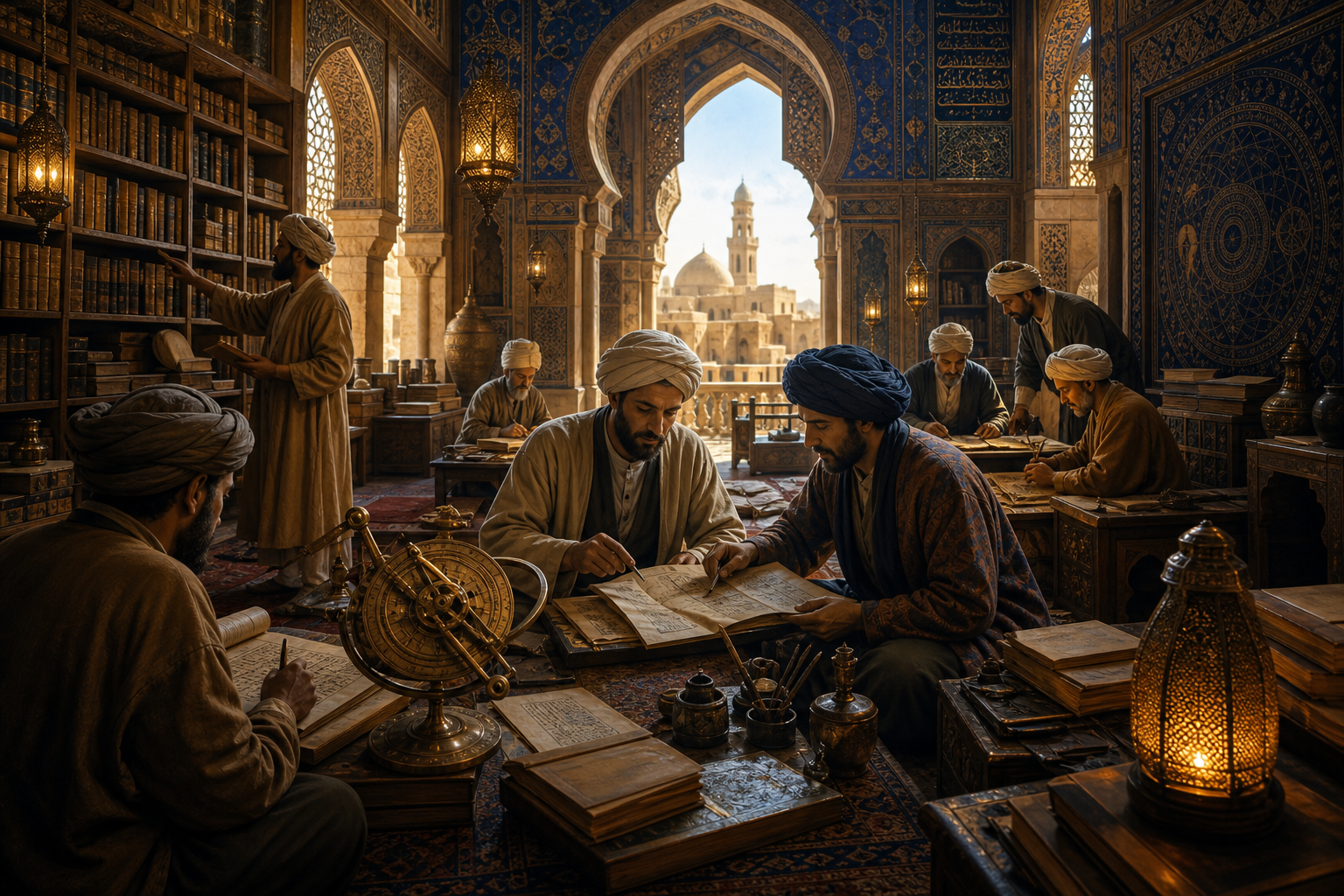
One of the great stories in the history of books is not a story of printing, but of translation. In eighth- to tenth-century Baghdad, scholars, physicians, patrons, scribes, and translators turned the Abbasid capital into a center of intellectual exchange. Greek, Syriac, Persian, Sanskrit, and other bodies of knowledge entered Arabic, were debated, corrected, expanded, and transformed.
This was not passive preservation. It was active intellectual work.
The phrase “House of Wisdom” (Bayt al-Hikma) is often used as a shorthand for the movement, though historians debate exactly what the institution was at different times: a library, bureau, scholarly circle, translation office, or all of these in some combination. Whatever its precise form, Abbasid Baghdad became a city where books mattered at scale.
Baghdad as a paper city
The material basis of the movement was paper. Papermaking spread from China into Central Asia and the Islamic world, with Samarkand often named as a key center. By the Abbasid period, paper was becoming central to administration and scholarship. Compared with parchment, it was cheaper and more suitable for copying large numbers of texts.
This mattered enormously. A translation culture needs texts to compare, copy, annotate, and circulate. It needs correspondence, notebooks, commentaries, medical manuals, astronomical tables, and mathematical treatises. Paper lowered the cost of intellectual abundance.
Baghdad was also an imperial capital. The Abbasid caliphs governed a vast, multilingual world. Bureaucracy required records. Medicine required manuals. Astronomy mattered for calendars, prayer times, astrology, and navigation. Philosophy and theology entered public debate. Translation served practical, political, and intellectual needs at once.
Translators as creators
Translation can sound mechanical, as if one language merely swaps words with another. In reality, translation across scientific and philosophical traditions requires conceptual invention. What should Arabic do with Greek philosophical terms? How should technical vocabulary be standardized? When a Greek text survives only through Syriac intermediaries, what counts as accuracy?
Figures such as Hunayn ibn Ishaq, a Christian physician and translator, became famous for their rigor. Hunayn translated Galen and other medical works, often comparing manuscripts and revising earlier versions. Translation here was close to textual criticism. It demanded philology, subject knowledge, and judgment.
The translated corpus included Aristotle, Plato’s later interpreters, Euclid, Ptolemy, Galen, Hippocrates, and works from Persian and Indian traditions. But Arabic-speaking scholars did not simply receive these texts; they argued with them. They corrected astronomical models, advanced algebra, developed optics, refined medicine, and produced original philosophy.
A cosmopolitan intellectual ecology
The translation movement complicates simple stories of civilization. It was not “Greek knowledge preserved by Arabs” in a static handoff. It was a multi-religious, multilingual, transregional scholarly ecology. Muslims, Christians, Jews, Sabians, Persians, Arabs, and others participated. Greek texts often passed through Syriac Christian scholarly networks before entering Arabic. Indian mathematics and Persian administrative traditions also mattered.
Books moved because people moved — and because patrons paid.
Caliphs and elites sponsored translations for prestige, utility, and curiosity. In some accounts, translators were paid in gold according to the weight of the completed manuscript. Whether literal or embellished, the story signals the value placed on books as objects of state and scholarly power.
Libraries, book markets, and readers
Baghdad’s book culture extended beyond courtly patronage. Book markets, copyists, paper sellers, binders, and private libraries formed an urban ecosystem. The historian al-Ya’qubi described Baghdad as a city of markets and professions; later accounts celebrate its booksellers’ quarter. Scholars collected, copied, lent, debated, and commented.
The book became a social object. It passed through hands, acquired marginal notes, generated commentaries, and anchored disputation. In Islamic scholarly culture, reading was often linked to oral transmission: texts were studied with teachers, heard, recited, authorized, and copied. The written page and the spoken chain supported one another.
This is a useful corrective to modern assumptions. Literacy cultures are not always silent or solitary. A manuscript can be the center of a live intellectual community.
Preservation through transformation
Some Greek works survived because they were translated into Arabic. Others are known through Arabic summaries, commentaries, or later Latin translations from Arabic. But the most important point is not merely survival. It is transformation.
Al-Khwarizmi’s mathematical work helped give Europe the words “algebra” and “algorithm.” Ibn al-Haytham’s work on optics influenced later scientific thought. Philosophers such as al-Farabi, Avicenna, and Averroes engaged Greek philosophy in ways that shaped Islamic, Jewish, and Christian scholastic traditions.
When twelfth-century translators in places like Toledo rendered Arabic philosophical and scientific texts into Latin, Europe received not “ancient Greece” untouched, but Greece refracted through centuries of Arabic scholarship.
Books as bridges, not relics
The Baghdad translation movement is one of history’s best arguments against cultural isolation. Great intellectual periods are often porous. They borrow, translate, dispute, adapt, and recombine.
Books made that porosity durable. A scholar can die; a school can fade; a city can be conquered. But a copied text can travel, wait, and awaken in another language centuries later. The fragility of books is real, but so is their stubbornness.
Baghdad’s lesson is not simply that civilization should preserve books. It is that preservation is most powerful when it leads to new thought. The highest tribute to a text is not to embalm it, but to understand it well enough to argue back.
Further reading
- Dimitri Gutas, Greek Thought, Arabic Culture
- Jonathan Lyons, The House of Wisdom
- Jim Al-Khalili, The House of Wisdom
- George Saliba, Islamic Science and the Making of the European Renaissance
- Jonathan Bloom, Paper Before Print